


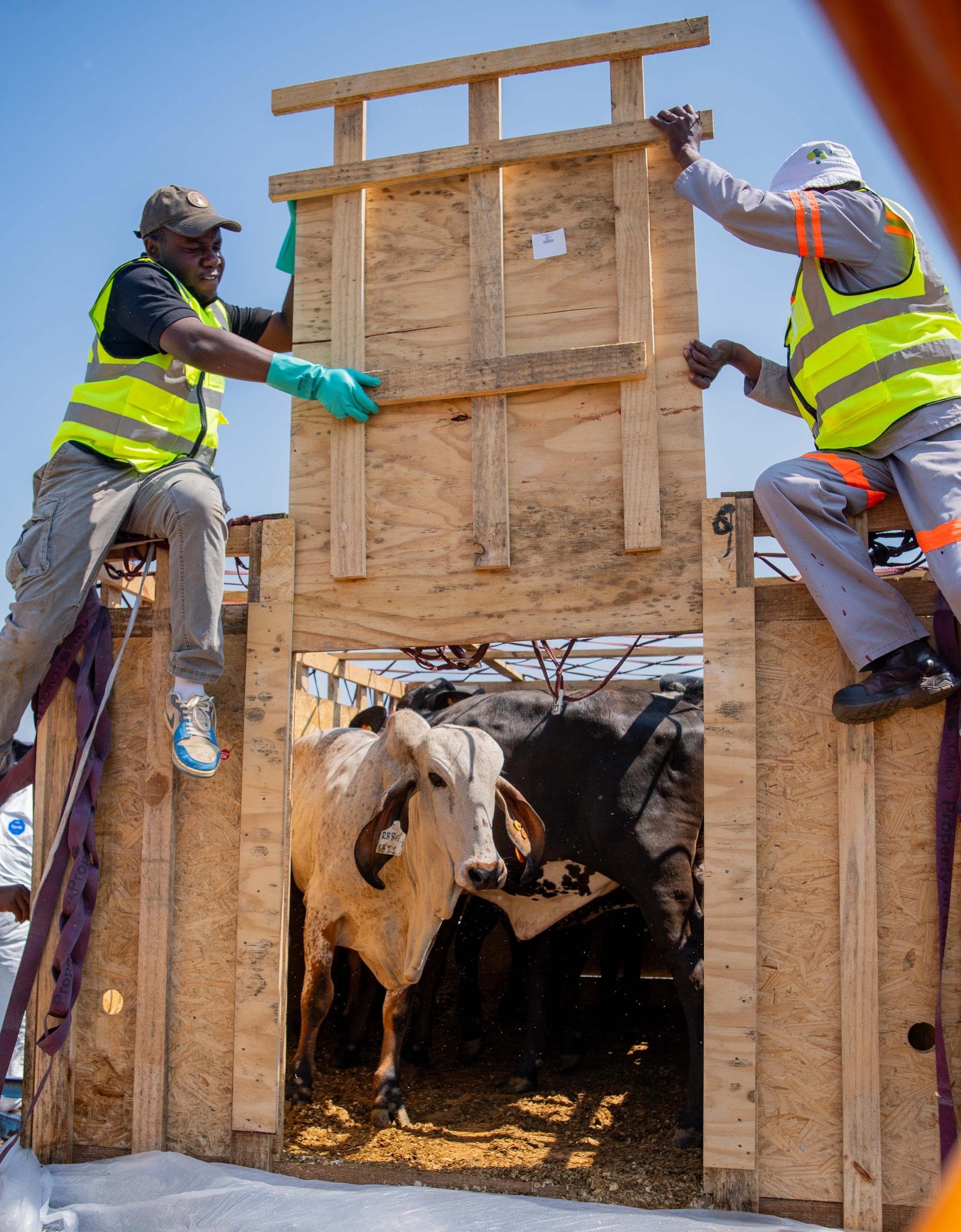
Botswana’s drive to strengthen domestic dairy production has received another boost with the arrival of 205 high-yield Girolando dairy cattle from Brazil, as Botswana Development Corporation (BDC) continues to scale its Milk Valley Farm investment in Lobatse.
The latest arrival is the second consignment, following the first consignment received in July. A further 206 cattle are expected within the next few days, bringing the total number of cattle imported from Brazil to 600.
Travelling with the latest consignment was the Minister of Trade & Entrepreneurship, Hon. Tiroeaone Ntsima, accompanied by BDC Chief Investment Officer, Ms Carol Jean-Haward. The Minister had travelled to Brazil for stakeholder engagement as part of the importation programme before accompanying the cattle to Botswana.
Reflecting on the significance of the project, Minister Ntsima said the arrival represented more than a milestone for Milk Valley Farm.
“Milk Valley Farm is strategically important because it speaks directly to some of our national priorities, strengthening food security, reducing our dependence on dairy imports and building a competitive domestic dairy industry.”
He added that the opportunity extends beyond primary milk production.
“This is the kind of productive investment we want to see: investment that builds local capacity, creates opportunities for our people and keeps more economic value within Botswana.”
The phased importation forms part of BDC’s broader programme to transform Milk Valley Farm into a modern, large-scale commercial dairy operation. The Girolando breed was selected for its milk-production potential, resilience and adaptability to warmer climatic conditions.
At full scale, Milk Valley Farm is targeting a herd of approximately 3,000 cattle and annual milk production of approximately 15 million litres. The project is intended to increase domestic milk production, strengthen food security, reduce reliance on dairy imports and contribute to the development of a more competitive local dairy industry.
For BDC Managing Director Mr Oteng Keabetswe, the project also reflects the importance of translating investment into tangible economic impact.
“This is an important milestone in BDC’s continued investment in Botswana’s productive capacity. We are building a modern dairy operation that will strengthen food security, reduce reliance on dairy imports and unlock opportunities across the dairy value chain.”
Mr Keabetswe said the impact of the investment should ultimately be measured beyond milk production.
“The impact goes beyond milk, it is about jobs, skills, citizen enterprise and creating more value here at home. At BDC, we are investing today to build the Botswana of tomorrow.”
As Milk Valley Farm expands, the project has the potential to stimulate opportunities across feed and fodder production, veterinary and animal-health services, transport and logistics, equipment maintenance, cold-chain services, breeding and distribution, while creating a platform for downstream dairy processing and value addition.
BDC has progressively invested in the infrastructure required to support this growth, including a 72-point rotary milking parlour, modern dairy housing, expanded water infrastructure, feed and fodder systems, modern herd-management and breeding systems, and strengthened biosecurity infrastructure.
Milk Valley Farm was also granted Foot and Mouth Disease-Free Dairy Compartment Status by Botswana’s Department of Veterinary Services in June 2026, strengthening the animal-health and biosecurity foundation required for the farm’s continued expansion.
The arrival of the second consignment is therefore more than another project milestone. It represents productive investment taking physical form, cattle on the ground, infrastructure in place and domestic production capacity being built.
With 205 cattle arriving in this consignment and another 206 expected within days, bringing the total imported from Brazil to 600, Milk Valley Farm continues to advance BDC’s ambition of building Botswana’s dairy future at home.


