


Botswana football is attempting to close a gap that has quietly followed its young players for years: what happens to their education when football takes them away from the classroom?
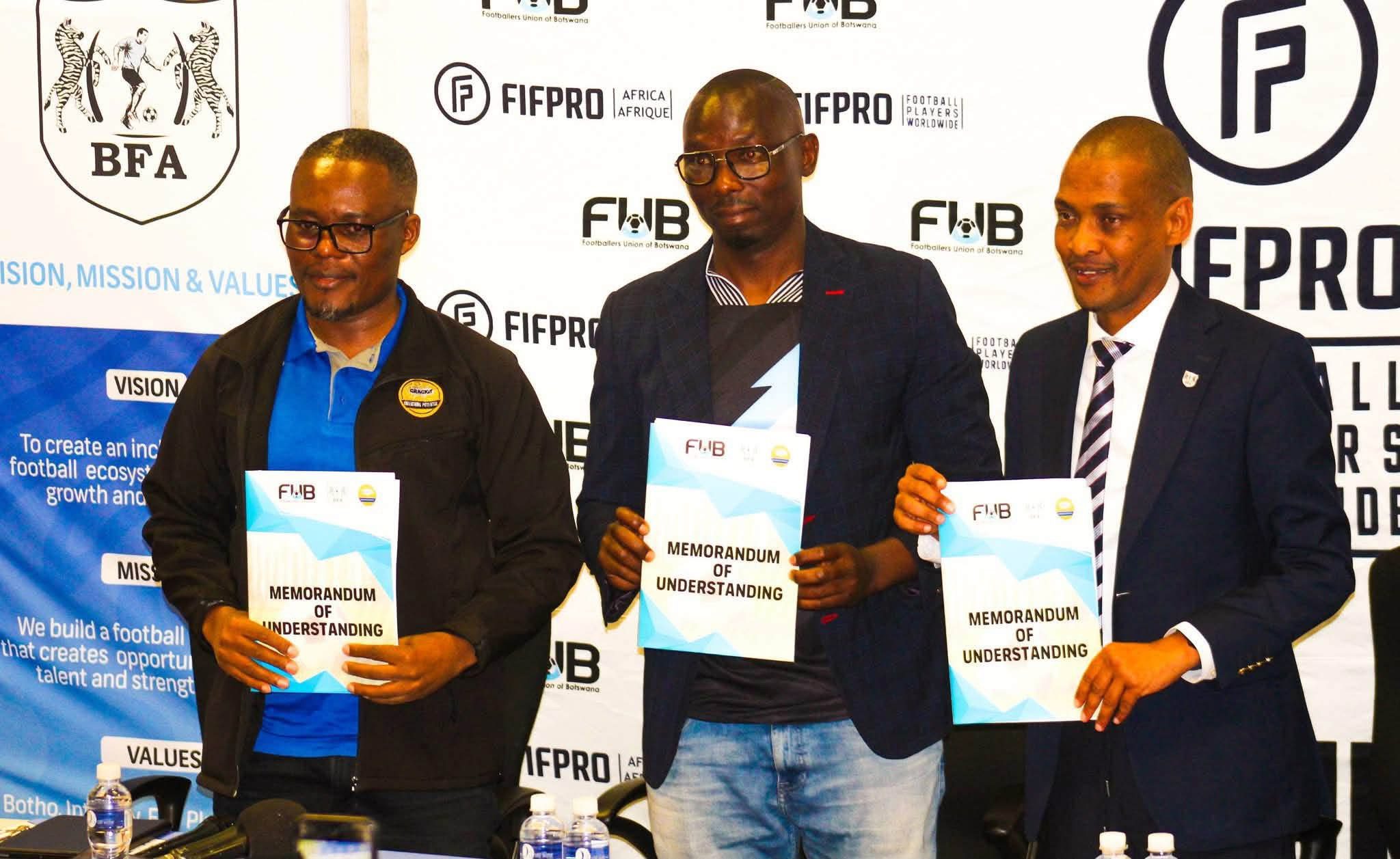
The Botswana Football Association (BFA), Footballers Union of Botswana (FUB), and Crack iT Botswana have now joined forces to address it, unveiling a long-term partnership on Wednesday designed to keep education alongside football, rather than behind it.
For BFA caretaker CEO Bathusi Rathari, the partnership is about more than improving footballers; it is about preparing them for life beyond it.
“Developing Football. Developing People. Developing Botswana,” Rathari said, framing the partnership around a simple question: “What happens to our players after football?”
The concern is particularly pressing for Under-17 players, many of whom travel for international competitions and camps at an age when their academic foundations are still being built. For players outside Gaborone, the consequences can be even more severe when they fall behind or fail at school.
Rathari said the BFA could no longer ignore that reality.
“An educated player is an empowered player,” he said, pointing to the ability of players to understand contracts, know their rights, and prepare for life after football.
FUB president Onalethata Thekiso echoed that concern, arguing that football must become more than a temporary escape from difficult circumstances.
“Football is a breeding place for the poor in this country,” Thekiso said, stressing that too many players who have played or are still playing have little to show for their years in the game.
His argument was blunt: when football ends, the absence of education can leave players with nowhere to go.
“The future of players is what matters the most,” Thekiso said. “We need to mould players with a better future.”
The partnership will see Crack iT provide academic support to student-footballers during camps, both locally and internationally. Tutoring and learning resources will be made available so that players do not have to choose between preparing for a match and preparing for examinations.
BFA and COSAFA president Tariq Babitseng said the idea was partly about restoring something Botswana football once had.
“We used to have future camps here when I was BFA CEO, and those players had tutors,” Babitseng said. “When we got into office, we realised that now it’s no longer there and there’s that gap.”
He believes the intervention could be decisive for players who may possess exceptional football ability but need additional academic support.
“Some people are gifted football-wise and not academically,” Babitseng said. “They need that little push.”
Babitseng also urged players to take advantage of opportunities already being created for them, noting that FUB has collaborations with institutions including CITF and Botho University.
“The office of FUB is there to guide you,” he said. “They are here to make you ready for the next life.”
For Crack iT director and COO Otukile Chaikwa, the partnership is an extension of the organisation’s belief that education remains essential throughout a footballer’s career.
“We believe in education. We believe that education in football is paramount,” Chaikwa said.
He explained that when players leave school behind while attending camps, a void is created. Crack iT’s role, he said, is to fill that space.
A local education company founded by Moemedi Senwelo in 2017 as a tuition centre, Crack iT has since expanded into a college and now wants to take its educational support wherever Botswana’s young footballers go.
“Everywhere youth teams will be camping, locally or internationally, Crack iT will be there to offer quality education,” Chaikwa said.
That geographical reach may prove to be one of the partnership’s most important features. It recognises that a player’s postcode should not determine whether education survives alongside their football ambitions.
The message from the three institutions was therefore remarkably consistent: football should open doors, not close them.
For Botswana, the ambition is bigger than producing the next Zebras or Mares star. It is to ensure that when the boots eventually come off, something remains.
As Rathari put it, the country must celebrate not only the goals, but the grades too.


