


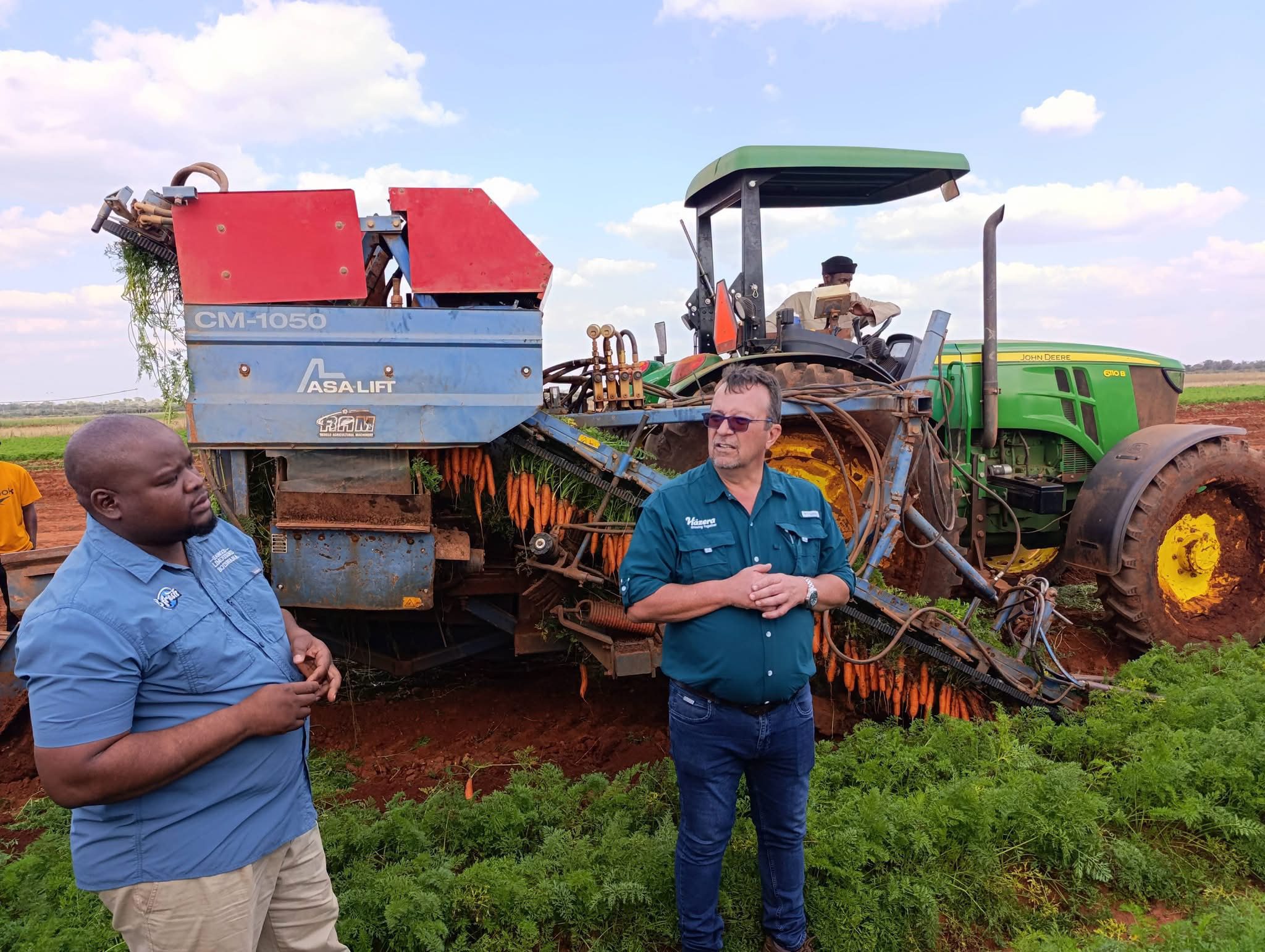
What began as an expensive lesson in growing the wrong crop has evolved into one of Botswana’s most sophisticated horticultural operations.
Fifteen years after settling on carrots as its core product, Lucerne Fields, the Tuli Block farming enterprise behind the B-Fresh vegetable brand, has grown into Botswana’s leading carrot producer, supplying retailers and informal traders nationwide while exploring regional export markets.
Managing Director Jan Stiglingh, said the company is now capable of supplying up to 400 tonnes of carrots to the local market monthly, a scale of output built not on favourable growing conditions but on sustained investment in irrigation infrastructure, production systems and post-harvest technology designed to compensate for the country’s harsh climate.
The business did not begin with carrots. After acquiring land in the Tuli Block and establishing irrigation infrastructure, Stiglingh initially targeted cabbages as a commercial entry point into vegetable farming. The assumption proved incorrect. Demand was weaker than anticipated, and the business struggled to absorb output at scale.
Onions and beetroot helped recover some of the losses, but around 2010 and 2011, Lucerne Fields made a decisive shift into carrots after identifying a structural gap in Botswana’s fresh produce market. Despite widespread scepticism about the viability of commercial carrot production in a hot climate, the company studied South African production systems before committing to the crop.
That decision effectively reset the business model. Today, carrots and beetroot form the backbone of production under the B-Fresh brand, which has become one of the more established vegetable labels in Botswana. Rather than competing on price alone, Lucerne Fields has positioned itself around consistency, quality control and cold-chain management.
According to Stiglingh, through investments such as its climate-controlled packhouse, a shift from the open-air facilities used in its early years, Lucerne Fields has significantly reduced post-harvest losses. Fresh carrots entering the facility are immediately moved into a controlled processing line where they are washed, sorted and cleaned through brush systems that remove surface impurities before undergoing hydrocooling, a process that rapidly reduces core temperature using near-zero-degree water.
By removing field heat within minutes of harvest, the company slows enzymatic breakdown and microbial activity that would otherwise shorten shelf life. Once cooled to between 0°C and 2°C, the carrots are graded, packed and moved into cold storage within a tightly controlled time window of under one hour from harvest to cold room. Stiglingh said this investment fundamentally changed the economics of production for Lucerne Fields.
“Once vegetables are harvested, the natural process of decay begins almost immediately. Before investing in the technology, carrots often remained marketable for only about a week, particularly during Botswana’s hot summer months. This investment has extended shelf life to between four and six weeks, significantly reducing losses for both the company and retailers,” he said.
The improvements also prompted the business to rebrand its produce from Tuli Carrots to B-Fresh, reflecting both the freshness of the product and its Botswana origins.
Beyond post-harvest systems, continuous reinvestment has become key to the company’s operating model. Lucerne Fields has improved water security through the construction of a weir on the Limpopo River, providing more stable irrigation during dry periods. Crop rotation involving maize, oats and cover crops has been introduced to manage soil health and reduce degradation from intensive vegetable production.
Waste streams from vegetable processing are also integrated into its livestock operation, where a Limousin cattle herd is used to convert residual biomass into additional value rather than incurring disposal costs.
More recently, the company has added solar generation and battery storage capacity in response to rising electricity costs, particularly those associated with cold storage and packhouse operations where energy demand is constant and non-negotiable.
Despite these efficiency gains, vegetable production in Botswana remains structurally expensive. Stiglingh said nearly all key inputs, including fertilisers, specialised seed varieties and agrochemicals, are imported from South Africa, making local production 10 to 15 percent more expensive.
As a result, competing directly with South African producers remains difficult. Instead, Lucerne Fields sees greater opportunities in expanding into regional markets with smaller domestic production bases. The company supplies the Zambian market, where Stiglingh believes demand offers greater long-term growth than Botswana’s relatively small population can provide, while also exploring opportunities in Namibia and Angola.
The constraint of Botswana’s small domestic market has also become increasingly apparent. Local demand does not always absorb supply, forcing periodic production adjustments and, in some cases, crop being ploughed back into fields during oversupply cycles.
Current economic conditions have also affected consumer spending, with tighter household budgets reducing vegetable sales across parts of the retail market.
Distribution remains anchored in formal retail channels, although informal traders and hawkers continue to absorb a meaningful share of output, particularly during peak supply periods. Lucerne Fields employs around 200 workers, making it one of the larger agricultural employers in the Tuli Block region.
While Lucerne Fields has received little in the way of direct production subsidies, Stiglingh said government policy has been important in shaping the commercial environment. Temporary import restrictions have created space for domestic production, while export facilitation has opened opportunities beyond Botswana’s relatively small market.
Access to finance has not been a binding constraint, although he said agriculture remains a higher-risk lending category requiring strong collateral structures and close engagement with financiers who understand production volatility.
“Farming is inherently more risky than many other industries,” he said, pointing to the importance of structured and transparent relationships with lenders.


