


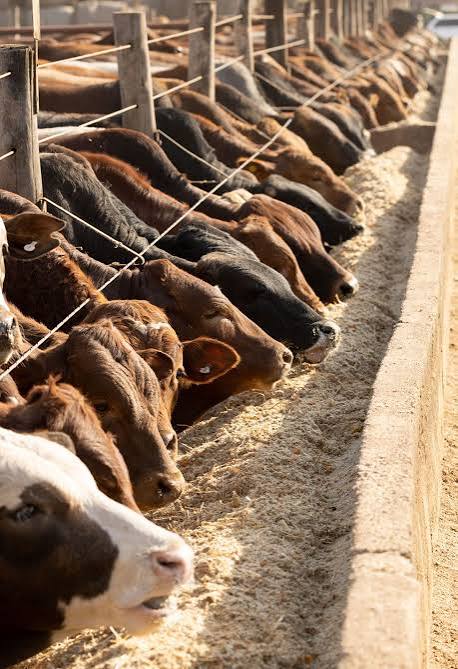
Foot-and-mouth disease has turned into a costly crisis for Botswana’s feedlot operators, with JS Beef and Primefast facing an additional P7 million a month to feed 6,600 cattle stranded by movement restrictions.
That comes on top of P27.8 million already incurred while the animals remain unable to move to slaughter. A recent High Court dismissal of their case has effectively closed off their latest attempt to break the deadlock.
Justice Onkemetse Tshosa ruled that the matter did not meet the requirements for urgency, denying the two feedlot operatorsrelief as they sought to move cattle that have been held for more than 300 days, well beyond their normal commercial finishing cycle.
JS Beef and Primefast, which together supply nearly 30 percent of Botswana’s export quota to the European Union, had approached the High Court seeking permission to immediately slaughter the cattle after failing to secure what they considered a workable route to slaughter and markets.
Their proposed solution involved controlled slaughter, deboning and the subsequent release of beef under veterinary controls.
Speaking to The Business Weekly & Review following the High Court’s dismissal of the joint urgent application, JS Beef Managing Director Jannie Strumpher said approximately 6,600 cattle had already accumulated P27.8 million in additional feeding costs.
At about P1,100 per head each month, he said the cost was increasing by a further P7.26 million for every month the cattle remain in the feedlots.
With the cattle having reached their optimal commercial weight months ago, Strumpher said further feeding no longer adds commercial value but continues to consume cash flow.
“Our discussions with our financiers are commercially confidential,” Strumpher said. “What we can say is that no responsible financier can provide unlimited funding for cattle that continue consuming feed while there is no certain date or lawful route to market. We do not have the financial means to sustain the cattle any further.”
Investment risk
The prolonged impasse, according to the feedlotters, has altered the risk assessment for investment in Botswana’s domestic beef value chain.
Strumpher said a private operator could inject substantial capital, maintain biosecurity measures, feed and thrice-vaccinate its herd, and secure ready buyers, yet still be left with finished cattle and no route to market because movement, slaughter and export channels remain subject to decisions outside the investor’s control.
He stressed that while FMD is a national animal-health emergency requiring rigorous management, private businesses cannot reasonably be expected to absorb unlimited losses indefinitely.
“The economic consequences of the control measures must also be anticipated and managed. Private businesses cannot reasonably be expected to absorb unlimited losses caused by prolonged restrictions without a workable mitigation mechanism,” Strumpher said.
“Investors require regulatory certainty, predictable access to markets, and practical contingency arrangements for foreseeable animal-disease events. If an investor can comply with every requirement and still be left indefinitely with thousands of finished cattle, mounting feed costs, and no alternative slaughter or marketing channel, future investment will inevitably be reconsidered,” he added.
The implications extend beyond the feedlots to the wider livestock value chain.
Feed suppliers, commercial hauliers, financial institutions and small-scale communal farmers have all been affected as the feedlots have remained unable to resume normal purchases of weaners.
Court setback
The attempt to unlock the bottleneck suffered a setback when the High Court dismissed the application with costs on procedural grounds, ruling that the matter lacked legal urgency.
The judge found that the operators were aware of the FMD movement bans as early as April 2 but only filed their court challenge in late July. They therefore failed to justify why the matter could not proceed through the standard court roll.
The court did not, however, determine the substantive legal correctness of the government’s measures or rule on the scientific validity of the controlled slaughter, processing and export options proposed by the feedlotters.
For JS Beef, the procedural nature of the judgment offers little comfort.
While its legal team evaluates options for a full judicial review or appeal, the ordinary timeline of the judicial process runs directly counter to the commercial reality facing the operators.
“The difficulty is that ordinary legal processes take time, while the commercial, financial, and animal-welfare consequences continue every day,” Strumpher said.
“Even if further proceedings ultimately succeed, they may not provide relief quickly enough to prevent irreversible damage. This was precisely why urgent relief was initially sought.”
The government’s defence in court rested largely on procedural and administrative grounds.
State legal counsel argued that the feedlotters’ grievances were primarily financial, encompassing feeding expenses, exhausted credit lines and potential insolvency, and that monetary losses could be quantified and compensated later through ordinary damages claims.
The state’s position remains that private economic losses, regardless of their severity, cannot dictate disease-control policy or compel court-ordered exemptions from biosecurity measures.
Alternatives fall short
Alternative routes proposed by government have so far failed to provide what the feedlotters consider a commercially viable solution.
On June 20, government announced that qualifying cattle could be transported to the Botswana Meat Commission (BMC) abattoir in Lobatse. However, the available option was slaughter for canning, which the operators said offered margins too low to make the exercise commercially viable.
BMC’s limited processing capacity also meant it could not process 6,600 cattle within what the operators considered a reasonable timeframe.
On August 19, government subsequently allowed cattle from containment zones to be slaughtered at Lobatse or Tsabong under strict maturation and deboning controls.
The operators, however, say an operational slaughter slot has still not materialised, leaving them without certainty over when the cattle can be processed or at what price.
Selling the cattle into the domestic market also does not solve the problem.
The operators say the domestic market does not have the capacity to absorb 6,600 cattle quickly without creating oversupply and putting further pressure on prices. Current prices are also below the level required to recover their accumulated production and feeding costs.
Seeking a trade route
JS Beef has pointed to World Organisation for Animal Health (WOAH) standards that support risk-based approaches to trade in animal products.
These can include vaccination, controlled transport, designated slaughter facilities, carcass maturation and deboning.
The company said South African buyers have already shown interest in both direct slaughter cattle and processed beef from the affected herds.
What is needed, according to the feedlotters, is government-to-government veterinary engagement to establish sanitary protocols that would allow exports to proceed safely.
“We are not asking for an exemption from legitimate FMD controls or for permission to weaken national biosecurity,” Strumpher said.
“We are asking for proportionate, scientifically defensible, and commercially workable measures. FMD does not automatically require the complete cessation of slaughter or trade.”
The standoff comes as Botswana seeks to attract more private investment into the livestock industry.
For feedlotters, however, the current crisis exposes a structural risk: private operators carry the capital and market risk, while access to slaughter and export markets can ultimately depend on a system that becomes difficult to access during an animal-health crisis.
“The private sector cannot be encouraged to invest while carrying all the commercial risk but having insufficient control over, or alternatives within, the route to market,” Strumpher said.


