


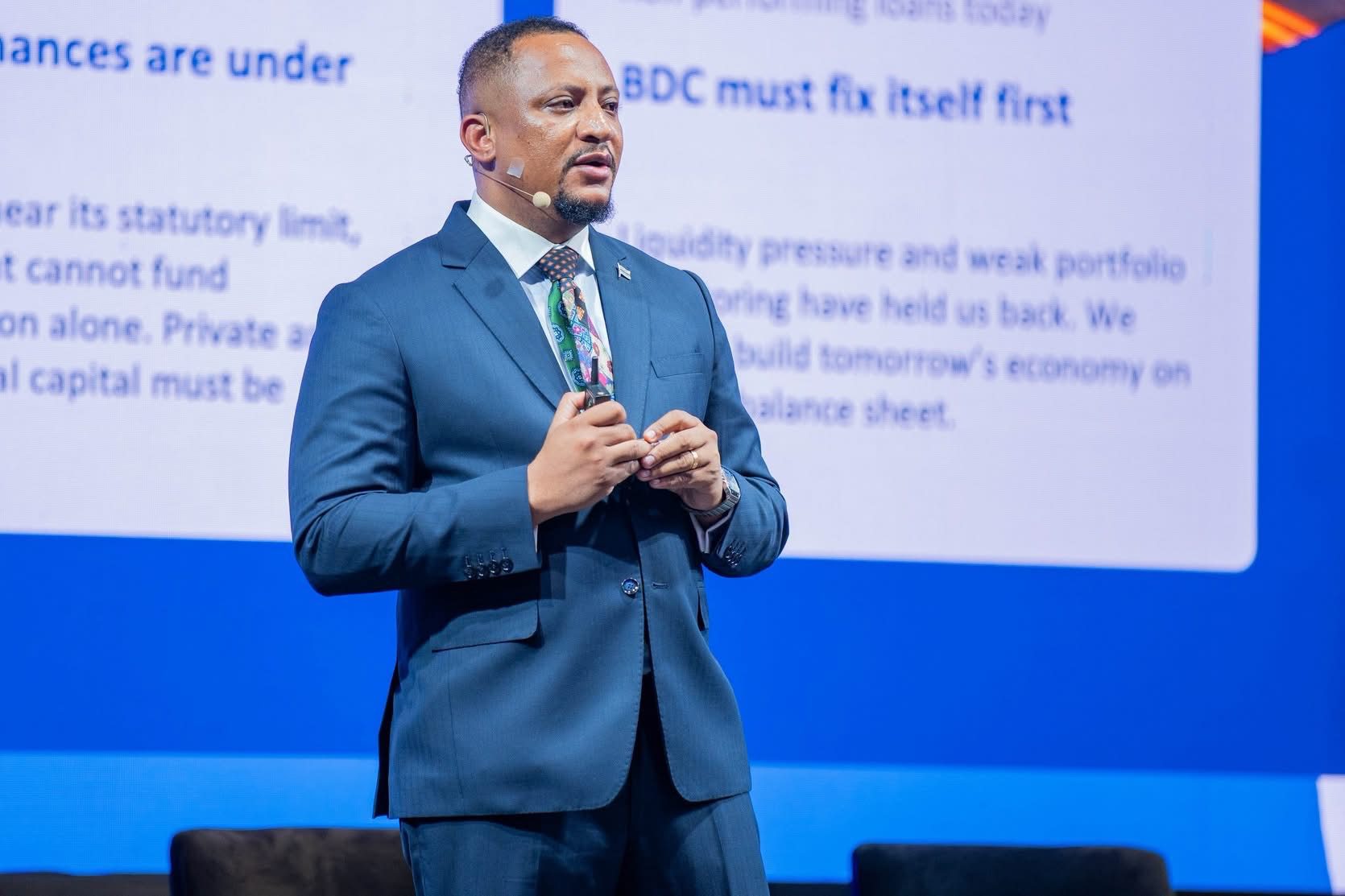
Botswana Development Corporation (BDC) plans to deploy P5.5 billion into priority sectors of the economy by 2031 as part of an ambitious strategy to attract private capital, build large domestic businesses and support Botswana’s economic diversification agenda.
The five-year investment drive forms part of a new strategy under which BDC intends to become what it describes as a mega investment company, shifting from a largely passive financing role towards becoming an active shareholder in businesses considered critical to the country’s economic development.
Speaking at the inaugural Botswana Investment Forum curated by BDC, Managing Director Oteng Keabetswe said the strategy, approved by the corporation’s board in June 2026 and endorsed by Cabinet the following month, targets the creation and preservation of at least 25,000 jobs.
“Diamonds can no longer carry the growth of this country alone,” he said, citing weak diamond demand, tight public finances and expensive capital.
With the economy having contracted by 2.8 percent in 2024 and 0.7 percent in 2025, while the fiscal deficit is projected at about 9 percent of GDP, Keabetswe said the transformation comes at a time when Botswana faces mounting pressure to diversify its economy. He argued that public money alone will not fund diversification.
Fixing the balance sheet first
While Keabetswe was bullish on the corporation’s new strategy, he acknowledged that BDC faces liquidity pressure, refinancing challenges and weak portfolio performance. Its first priority is to stabilise liquidity, refinance part of its debt on commercial terms and recycle about P2 billion in assets into more productive industries.
The asset recycling programme is intended to release capital tied up in existing investments and redirect it towards businesses with greater potential to generate employment, replace imports and increase exports.
BDC also plans to eliminate its structural liquidity gap, which Keabetswe said currently stands at just over P300 million, compared with approximately P400 million last year. He explained that the gap reflects a mismatch between cash generated by the corporation’s investments and the amounts required to meet capital repayment obligations.
Having committed to publishing annual progress reports against these targets, with an independent mid-term review scheduled for 2029, Keabetswe noted that BDC will also seek to keep non-performing loans at no more than 15 percent and generate a minimum return on equity of 6 percent, allowing it to reinvest earnings into the economy.
Building national champions and future stars
Beyond repairing its finances, BDC intends to change how it identifies, finances and manages investments with Keabetswe announcing that the corporation will allocate 30 percent of its investment capital, towards developing what it calls “national champions,” which are strategic, capital-intensive businesses in which BDC would take long-term ownership positions.
The objective, he noted, is to support the emergence of large domestic companies capable of operating at scale and contributing to the country’s economic transformation.
A second investment category, described as “future stars,” will target medium and large enterprises with the potential to expand their operations, while startups and emerging industries will be supported primarily through co-investments and partnerships with other investors.
Rather than relying solely on its own balance sheet to support its seven priority sectors, including agribusiness, healthcare, energy and financial services among others, BDC plans to set up investment funds and co-investment structures that will allow pension funds, private equity firms and development finance institutions to invest alongside it.
Botswana’s savings paradox
In his presentation at the investment forum, Keabetswe highlighted what he described as a contradiction in Botswana’s financial system, saying the country has substantial domestic savings but continues to struggle to mobilise sufficient capital for productive investment.
“We are savings rich, but capital scarce,” he told delegates.
According to figures he presented, Botswana’s pension funds hold more than P158 billion in assets, yet only approximately 45 percent of those funds are invested domestically.
He said less than 5 percent of capital was invested in private equity and venture capital, while private sector credit stood at approximately 30 percent of GDP, compared with around 55 percent in comparable regional economies.
Citing the pension fund localisation requirements, which seek to increase domestic investment to 50 percent by 2027, Keabetswe said an estimated P8 billion in additional capital could be brought into the local economy.
However, he warned that the availability of savings does not automatically translate into investment in businesses, with the challenge, as he suggested, now being to develop commercially viable projects and investment structures capable of attracting institutional investors while delivering acceptable returns.
Confidence at the centre of investment drive
Keabetswe said attracting investment would ultimately depend on the confidence investors have in local institutions, businesses and the quality of projects seeking financing.
He argued that global capital increasingly flows towards economies able to demonstrate credible institutions, resilient businesses and commercially sustainable investment opportunities.
Under the corporation’s new strategy, BDC seeks to position itself as a vehicle through which domestic savings and international capital can be channelled into productive economic activity.
However, delivering the P5.5 billion investment programme, Keabetswe noted, will require BDC to address its existing financial constraints while building a sufficiently strong pipeline of investable projects.
“Capital follows confidence,” he said. “Let’s build it together.”


