


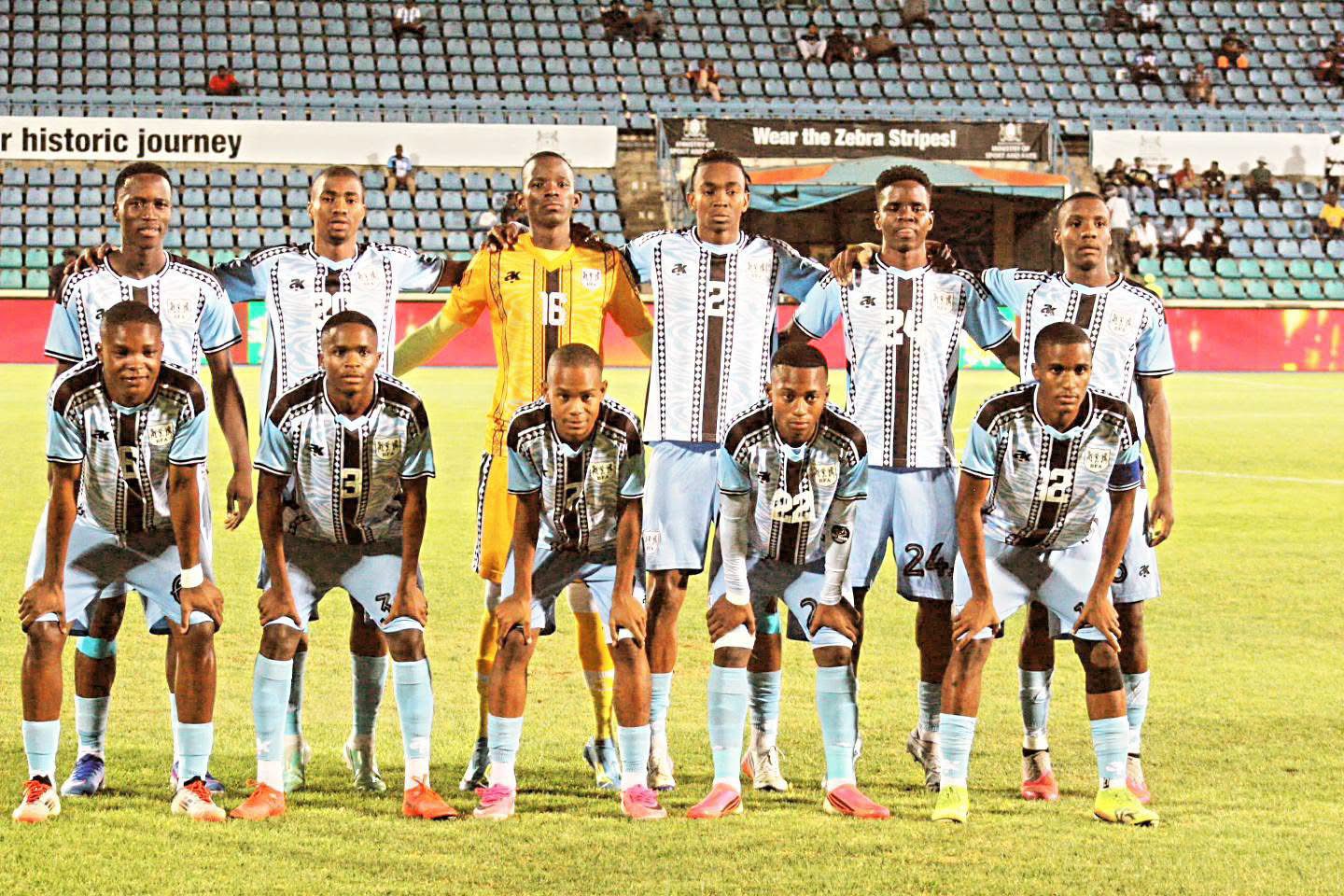
Botswana’s senior and Under-23 national football teams face defining assignments in the coming days, with qualification hopes, continental ambitions and competitive credibility all on the line.
While the Zebras seek to strengthen their position in the 2027 Africa Cup of Nations qualifiers against Uganda, the Young Zebras must overturn a first-leg deficit against Guinea to keep their U-23 AFCON campaign alive.
The two assignments present different challenges but share a common requirement: the ability to deliver results when the stakes are highest.
For the senior Zebras, the immediate focus is a potentially decisive double-header against Uganda in the TotalEnergies CAF Africa Cup of Nations Morocco 2027 qualifiers.
The first encounter is scheduled for November 14 at Hoima City Stadium, with kick-off at 19:00 local time, before the teams meet again in Botswana on November 17.
The Zebras enter the international window with two points from their opening two matches after securing consecutive draws against Libya and Tunisia.
Although neither result delivered maximum points, both performances demonstrated the team’s ability to compete away from home.
The challenge now is converting resilience into victories.
Uganda currently lead Group H with four points, giving them a narrow advantage over Botswana, who sit second with two points.
The double-header therefore offers the Zebras an opportunity to close the gap and potentially move above Uganda in the qualification standings.
History, however, provides little comfort. Uganda have won all five previous official meetings between the two countries, including consecutive 1-0 victories in the 2026 FIFA World Cup qualifiers in June 2024 and October 2025.
Their AFCON qualifying meetings in 2015 and 2016 also ended in Ugandan victories.
Sports journalist and football analyst Duncan Kgangkenna believes the upcoming fixtures represent an important test of Botswana’s development as a competitive international side.
“The double-header against Uganda is arguably one of Botswana’s most important assignments in this qualifying campaign. The two consecutive draws against Libya and Tunisia demonstrated that the Zebras can compete away from home, but they now need to translate that resilience into victories. Two points from the opening matches provide a foundation, but qualification campaigns are ultimately decided by how teams perform in these defining encounters,” Kgangkenna said.
The challenge extends beyond the points available. Uganda’s historical dominance means Botswana must overcome both the pressure of the occasion and a record that has consistently favoured their opponents.
Kgangkenna argues that history should not define Botswana’s approach.
“Uganda’s head-to-head advantage cannot be ignored, particularly because Botswana have yet to register an official victory against them. However, historical statistics do not necessarily determine what happens on the pitch. Botswana must approach these matches with tactical discipline, confidence and a clear understanding of how to exploit Uganda’s weaknesses. The challenge is not simply to avoid defeat but to demonstrate that this team has developed the mentality to compete for qualification,” he said.
While the senior side prepares for a crucial qualification battle, the Young Zebras face a more immediate elimination threat.
The Under-23 national team suffered a 1-0 home defeat to Guinea in the first leg of the second round of the 2027 U-23 Africa Cup of Nations qualifiers on November 11 at the Gaborone National Stadium.
A first-half goal from Mohamed Toure proved decisive, leaving head coach Michael Mogaladi’s side with the difficult task of overturning the deficit in the return leg in Guinea on November 17.
The result interrupted a promising qualification campaign that had begun with Botswana defeating Seychelles 4-2 on aggregate in October through consecutive 2-1 victories.
The Young Zebras had also enjoyed an encouraging September preparation period, highlighted by a 5-1 victory over Eswatini, although narrow defeats to Eswatini and Mozambique exposed areas requiring improvement.
Speaking after the loss to Guinea, Mogaladi acknowledged the disappointment but defended the effort of his players and technical team.
“We lost. This game has taught us a lot of things and it was a tough game. The truth is that our players did all they could to try and win the match. My technical team tried their best to an extent where we exhausted our thinking and even had an injury,” he said.
The coach admitted that Botswana struggled to impose themselves on the contest.
“We didn’t come much to the party. We tried our best. It’s what we had, what we did. The team played well even though we lost,” he said.
The return leg now carries enormous significance.
Botswana must win by two clear goals to qualify outright, while a one-goal victory would take the tie to a penalty shootout if the aggregate score is level after regulation time.
For Kgangkenna, the narrow defeat should not be viewed as the end of Botswana’s ambitions.
“The 1-0 defeat is disappointing, particularly because Botswana had home advantage, but the tie is not over. A one-goal deficit remains recoverable, although playing away in Guinea presents a considerably different challenge. The Young Zebras must be more decisive in the final third and ensure that their defensive organisation does not expose them to another setback,” he said.
The assignment also places responsibility on Mogaladi and his technical team to make the necessary tactical adjustments without undermining the confidence of the players who carried Botswana through the opening qualification round.
“What makes this international window particularly interesting is that both the senior and Under-23 teams are facing significant tests of their competitive maturity. The Zebras have an opportunity to challenge Uganda’s dominance, while the Young Zebras are fighting to keep their continental ambitions alive. These are different competitions, but both require a stronger winning mentality, better execution and consistency at international level,” Kgangkenna added.
For the Young Zebras, progression would preserve hopes of reaching the 2027 U-23 Africa Cup of Nations in Egypt and sustaining ambitions of qualifying for the 2028 Los Angeles Olympic Games.
For the senior team, the Uganda fixtures present an opportunity to reshape Group H and demonstrate that the draws against Libya and Tunisia were more than isolated displays of resilience.
The two campaigns are unfolding on different fronts, but their significance extends beyond immediate results.
They represent opportunities for Botswana’s national teams to establish greater consistency and competitiveness on the African stage.
The coming days will reveal whether the Zebras can finally break their Ugandan hoodoo and whether the Young Zebras possess the resilience to recover from their home setback.
For both teams, the margin for error is narrowing.


