


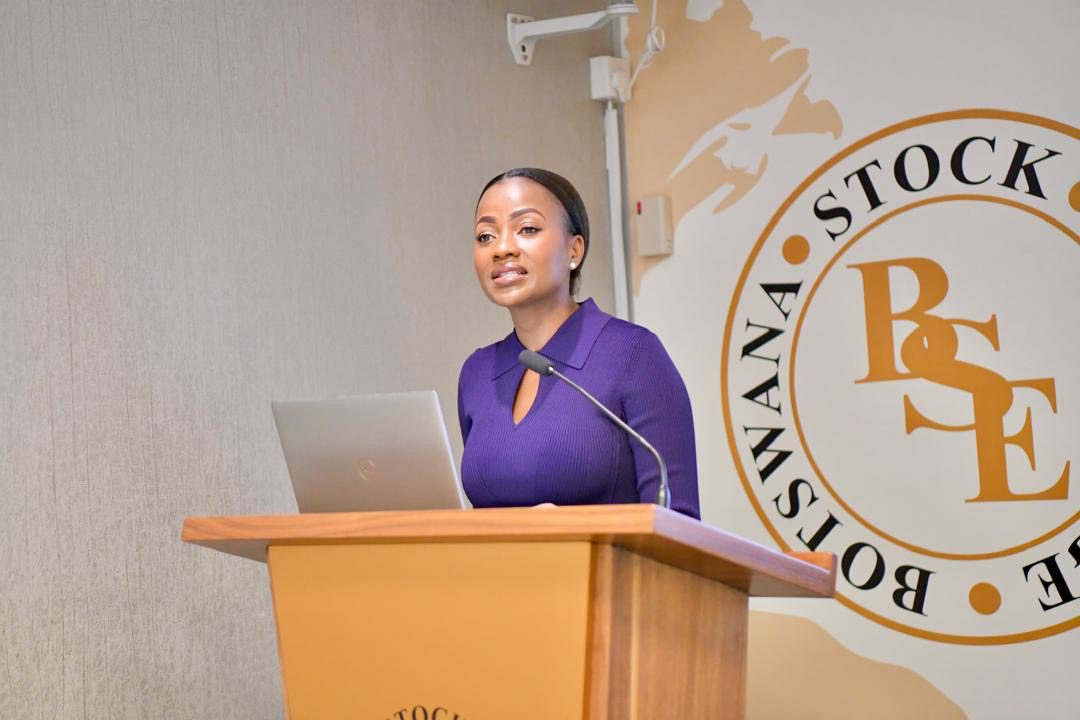
When Thapelo Tebogo Moribame joined the Botswana Stock Exchange in August 2016, she arrived as an economist entering a highly specialised securities world. A decade later, she is recognised by the World Federation of Exchanges as one of the Top 20 Women Leaders globally, not for mastering the technical language alone, but for rewriting who the market is for.
Her journey, she says, has always been about onethread: connecting people and businesses to opportunity.
She holds a Master of Commerce in Economics from Stellenbosch University and studied international trade in Tokyo, an academic foundation in how economies and markets interact. But it was the field that forged her commercial focus.
“My academic background gave me a strong foundation in economics, international trade and an understanding of how economies and markets interact, but it was my professional journey that really shaped my commercial outlook and, importantly, my understanding of inclusion and access to economic opportunity,” she says.
Early work in international trade exposed her to market access, competitiveness, and the role of institutions and policy in connecting businesses beyond their immediate markets. Then came the Local Enterprise Authority (LEA) a formative chapter.
“I was closely involved in SME development. Working with small and growing businesses made the challenges around access to finance, business capability, governance, market access and growth very tangible. I saw first-hand that many businesses have the ambition and potential to grow, but often lack the structures, resources or access to capital required to move to the next level,” says Moribame.
That experience, she notes, directly informs her work at the BSE today.
“That experience has stayed with me throughout my career and, in many ways, connects directly to the work I have done around SME development at the BSE. Initiatives such as the Tshipidi Mentorship Programme and promoting access to capital markets by those that are outside that circle are informed by that same belief: that businesses should not be excluded from capital markets simply because they are at an earlier stage of development.”
Her stint as Marketing Manager at Air Botswana added the final dimension; commercial thinking, customer understanding, value communication, partnership building and resilience.
“I don’t see capital markets simply as financial infrastructure; I see them as an enabler of economic participation. Whether we are talking about an SME raising capital, an institutional investor deploying long-term savings, a young person learning about investing, or an ordinary Motswana seeking to build wealth, there must be a place for them in the market,“ she explains.
Learning the Exchange
Entering the BSE was a steep, exciting learning curve.
She realised that the opportunity is bigger than herself, knowing that market development is not simply about growing the size or activity of an exchange. She says it is about impact and building a market that works, one that can provide businesses with access to capital, give investors appropriate opportunities, maintain confidence and ultimately contribute to economic development,” Moribame notes.
Coming from a broader economic background, she had to learn quickly, master the technical language, and appreciate the non-negotiables of market integrity.
In an exchange environment, Moribame says every decision sits within a framework of rules, disclosure, governance and investor protection. That required her to develop a strong appreciation of the discipline behind capital markets and the responsibility that comes with operating and developing a market.
She also learned how interconnected the ecosystem is. “An exchange does not operate in isolation. Its effectiveness depends on issuers, investors, brokers, custodians, regulators, advisors, government and other market infrastructure working together.
Why the World Noticed
In 2025, the World Federation of Exchanges named her among its Top 20 Women Leaders. For Moribame, the honour reflects collective impact.
Ultimately, she avers that the recognition reflects a combination of leadership, determination, collaboration and impact. Her biggest motivation has been seeing tangible change in the 10 years that she has been at the BSE in terms of more businesses accessing capital, more people participating in investment, stronger partnerships and a market that is increasingly relevant to Botswana’s economic development.
She is especially proud of initiatives that take the market beyond institutional walls; into schools, tertiary institutions, communities, national expos, and digital tools such as the stock market simulator and the planned online trading platform.
“Financial inclusion is not just a strategic objective for me; it is a personal commitment. I want people to understand that capital markets can be part of their financial lives and that businesses, regardless of size or stage, can have a pathway into the market.”
Under her team, the BSE has broadened its product range, strengthened investor education, nurtured the SME pipeline through Tshipidi, and deepened local and international partnerships.
“Internationalisation has also been an important part of that journey. Most recently, I organised Botswana Day in London, bringing together investors and stakeholders to showcase Botswana’s capital market and broader investment proposition. For me, that was more than an investor engagement event; it was about actively connecting Botswana to international pools of capital,” she says.
Making the BSE Relatable
Moribame’s core conviction is disarmingly simple: “The stock exchange is not reserved for institutions and experts. It belongs to every Motswana and to every business with ambition. Our task has been to demystify it.”
That demystification is anchored in the BSE’s 10X by 2030 strategy and its vision of becoming Africa’s premier capital raising hub.
On the issuer side, the strategy is pipeline-driven, engaging Botswana-owned businesses, family enterprises and state-owned enterprises, and leveraging SME mentorship and business development programmes such as the Tshipidi Mentorship Programme, Stanford Seed, Debswana CEEP and BDC partnerships to identify high-potential firms. International engagement across the USA, Zimbabwe, Canada, UK, Luxembourg, Nigeria, Australia, Singapore, Abu Dhabi, Dubai and the rest of Africa supports both issuer identification and investor relationships.
The value proposition is dual. “To issuers, we present the BSE as a capital raising platform: an accessible platform through which businesses of every size can raise long-term capital, enhance their visibility and credibility, and strengthen their governance. To investors, we present the BSE as a platform for wealth creation, offering the opportunity to own a share in the growth of listed companies, earn dividends and build wealth over the long term. When both sides benefit, the market deepens,“ she elaborates.
Underpinning it all is education, still her greatest focus.
For investors, she says they take the conversation into government departments, schools, tertiary institutions, churches, SACCOs, metshelo and national expos, supported by educational videos, brochures, webinars, their stock market simulator and investor activities. The BSE also offers one-on-one meetings, workshops, webinars and the Tshipidi Mentorship Programme, which translates listing requirements into practical, achievable steps.
Alliances That Deepen the Market
“Market development is, by its nature, collaborative. No single institution can deepen a capital market on its own,” Moribame notes. Her alliances deliberately advance two pillars of BSE strategy: Internationalisation and Force for Good.
The partnership with Botswana Development Corporation is emblematic. BDC’s portfolio of enterprises at different growth stages creates a structured pathway; from investment readiness and capacity building to the appropriate board on the Exchange. It also opens joint work on new financial instruments, shared investor engagement platforms and an infrastructure fund to mobilise long-term capital. For BDC, the market offers value realisation; for the BSE, a quality issuer pipeline. A similar logic drives the partnership with Gaborone City Council to explore municipal bonds for local infrastructure.
Internationally, she says memberships provide voice and reach. As a member of the African Securities Exchanges Association, she says the BSE has joined the live network of the African Exchanges Linkage Project, allowing investors and brokers to access multiple African exchanges through a single entry point. Through the Committee of SADC Stock Exchanges, it helps harmonise listing, trading and settlement frameworks. World Federation of Exchanges membership keeps it aligned to global best practice.
“Further afield, the BSE became the first African exchange to join the Tabadul cross-border trading platform with the Abu Dhabi Securities Exchange, and the BSE has established a commodity tradingcorridor with DMCC in Dubai. Together with investor showcases such as Botswana Day in London, these alliances position Botswana as a connected market and a gateway into the region, rather than a standalone exchange,“ she says.
Global Standards, Local Realities
With roles on ASEA’s Policy Working Group and the UN Advisory Group on SMEs, Moribame balances global best practice with Botswana’s realities with care.
“Global best practice is a great reference point, not a template that should be applied without considering local circumstances. Botswana’s capital market has its own scale, investor base, economic structure and development priorities, so our role is to understand international developments and adapt the relevant principles to our market,” she says.
Her work on ASEA’s Advisory Group on SMEs and Sustainability brought exposure to how other markets approach sustainability, SME financing, market access and policy, while contributing Botswana’s perspective.
Locally, she says this means focusing on practical outcomes: strengthening governance and disclosure, improving access to capital, supporting private-sector growth and widening participation in the market. Ultimately, she adds that the balance is about being internationally credible while remaining locally relevant.
Why List Instead of Borrow
For mature, privately owned companies weighing bank debt against listing, Moribame’s pitch is structural and human.
She explains that listing provides access to capital, but also delivers value well beyond the capital raised: a transparent market valuation, liquidity for existing shareholders, a clear route for succession planning or a partial exit for founders, and the enhanced profile and credibility that come with operating under strong governance and disclosure standards. For companies that prefer debt, the BSE bond market offers an alternative to bank lending, allowing them to raise funds directly from investors.
And the BSE is designed as a progression, not a cliff. The Serala OTC Board acts as an incubator for aspiring issuers to build visibility and familiarity with disclosure and governance. From there, companies can progress to the Tshipidi SME Board, the Venture Capital Board and ultimately the Main Board.
“Our role is to make that journey less daunting. We engage owners and boards one-on-one to assess readiness and identify the most suitable board, and host workshops and webinars alongside advisors from the listings ecosystem.”
SMEs are Botswana’s economic lifeblood, but many struggle with corporatisation, the governance, financial reporting and transparency investors demand. The Tshipidi Mentorship Programme was built to fix that.
She says Tshipidi is a practical, interactive programme that grooms businesses to raise capital, strengthen their governance and use the BSE as a springboard for growth. It is facilitated by industry experts from across the listings ecosystem and covers the core elements a company needs to be investor-ready: corporatisation, capital structure, financial reporting, commercial law, listing requirements and corporate governance.
To date, 79 companies have been mentored. Even those not yet ready to list leave better structured, better governed and more attractive to any capital provider. The programme links directly to the Tshipidi SME Board, which has less stringent requirements and offers a home for growth.
“We are strengthening this pipeline through partnerships which aligns its investee companies with listing pathways, and through the Stanbic partnership waived listing fees for the first SME listings to lower the barrier to entry,“ she states.
On global integration, Moribame presents Gaborone’s competitive advantages with precision.
“The first is openness. Botswana has no exchange controls, so there are no restrictions on the inflow and outflow of funds. For a foreign issuer, this means capital raised can be deployed where it is needed, and dividends and proceeds can flow freely to shareholders.”
That openness is underpinned by stability, an unbroken democratic tradition since independence, peaceful transitions of power, strong rule of law and a conducive macro-economic environment.
Issuers also benefit from a well-regulated market. The BSE is demutualised, regulated by NBFIRA, with listing and disclosure standards aligned to international practice and fully electronic trading, clearing and settlement. Moribame says recognition by His Majesty’s Revenue and Customs in the United Kingdom further promotes the BSE as viable for UK investors.
“Perhaps most compelling is the depth of capital available. Botswana’s pension funds and other institutional investors hold a large pool of long-term contractual savings that is actively seeking quality instruments to invest in. With more capital chasing a limited number of local assets, well-positioned issuers find a receptive and sophisticated institutional investor base, complemented by a growing community of retail investors,“ she explains.
The proof is already listed: foreign companies from the UK, Canada, Australia and across Africa, spanning mining, energy and financial services. Moribame says as a multi-product, multi-currency exchange, their strategic position offers issuers a gateway to the wider SADC region. For a company seeking a foothold in Southern Africa, Gaborone offers openness, stability and capital in a single destination, according to Moribame.
Bringing Ordinary Batswana In
Low retail participation challenges many African exchanges. Moribame’s answer has been to go where people are, in plain language.
Morobame says they take investor education to where people are: government departments, schools at every level, tertiary institutions, churches, SACCOs, metshelo, employers and nationwide expos. In plain language, she says they explain how the market works, the products available, from shares and bonds to ETFs, and how to start investing through a licensed stockbroker. At expos and campus engagements, the BSE helps prospective investors open accounts on the spot, reinforced by videos, brochures and webinars.
Digitally, the BSE Stanbic Bank Stock Market Simulator gives anyone a risk-free environment to learn by doing, with competitions adding fun and recognition. Under its Technology Modernisation pillar, an online trading platform and Retail Investor Module will allow investors to trade and monitor portfolios conveniently.


