


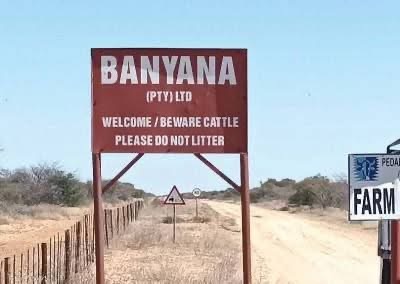
Banyana Farms, the state-owned agricultural company, has sought to explain the lease of a large ranch to former President Mokgweetsi Masisi, insisting that the transaction complied with the law and that the company’s management played no role in the decision.
The lease, a renewable 15-year term for a 49-square-kilometer ranch, was awarded to Masisi in 2020 after he outbid several highly qualified applicants. At the time, the award drew scrutiny over potential conflicts of interest.
Mothoemang Hudson Gabaitse, a former general manager of Banyana Farms, told Parliament’s standing committee on statutory bodies and state enterprises that public servants in the Ministries of Agriculture and Lands were responsible for selecting the winning bidders.
Gabaitse said Masisi had applied for a single plot, Lot 2, while a competitor applied for both Lot 2 and Lot 5. “The tender terms allowed any interested individual to apply for more than one lot,” Gabaitse said. “The other party applied for both Lots 2 and 5, then scored high marks on Lot 5 and settled for that lot.”
He also revealed that Banyana Farms has been run according to presidential directives, operating without a fully constituted board since 2015. The company’s books were not audited until 2022 and 2023.
Gabaitse said the absence of a proper board hampered auditing, in part because the company lacked skilled personnel such as accountants. As of Monday, he said, Banyana Farms had a cash balance of P61,000 — a development the parliamentary committee said raised serious questions about governance, transparency and accountability.
“Banyana Farms is owed over P600,000 in unpaid leases, and there are follow-ups regarding payments,” Gabaitse added.
At the time of the ranch lease, media reports showed that tender documents required all bidders to visit the farm and submit to an interview with Banyana Farms assessors at the offices of Botswana’s attorney general. Mr. Masisi met neither condition. Instead, he sent representatives to view the farm and arranged for the interview to take place at State House in Gaborone.
The tender documents also specified that bidders should not already own a ranch in Botswana. Yet Masisi was engaged in commercial livestock production and horticulture at Matseta, near Gaborone, where he grows vegetables and raises cattle and small stock. His family has also inherited a farm at Sekoma used for commercial livestock, and he is said to operate a feedlot in Moshupa as well as farms at Tshele and Morupule.
Last year, responding to a parliamentary question about Masisi, the acting minister of agriculture and lands, Dr. Edwin Dikoloti, said the former president had been awarded 4,946.7890 hectares of land under a sublease running from Aug. 1, 2020, to July 31, 2035. Dr. Dikoloti added that the lease was renewable for an additional 15 years, subject to compliance with the agreement’s terms and the renewal of the head lease.
Banyana Farms was originally owned by the Commonwealth Development Corporation, which built substantial infrastructure on the property, including farmhouses, quarters for farmhands, airstrips and numerous boreholes spread across the ranch. After taking over ownership from the corporation and operating the ranch for several years without much success, the Botswana government decided to subdivide the vast tract into smaller ranches and lease them out to interested farmers. Part of the ranch was also allocated to the Botswana Meat Commission, a state utility, to develop feedlots aimed at improving livestock for slaughter.


