


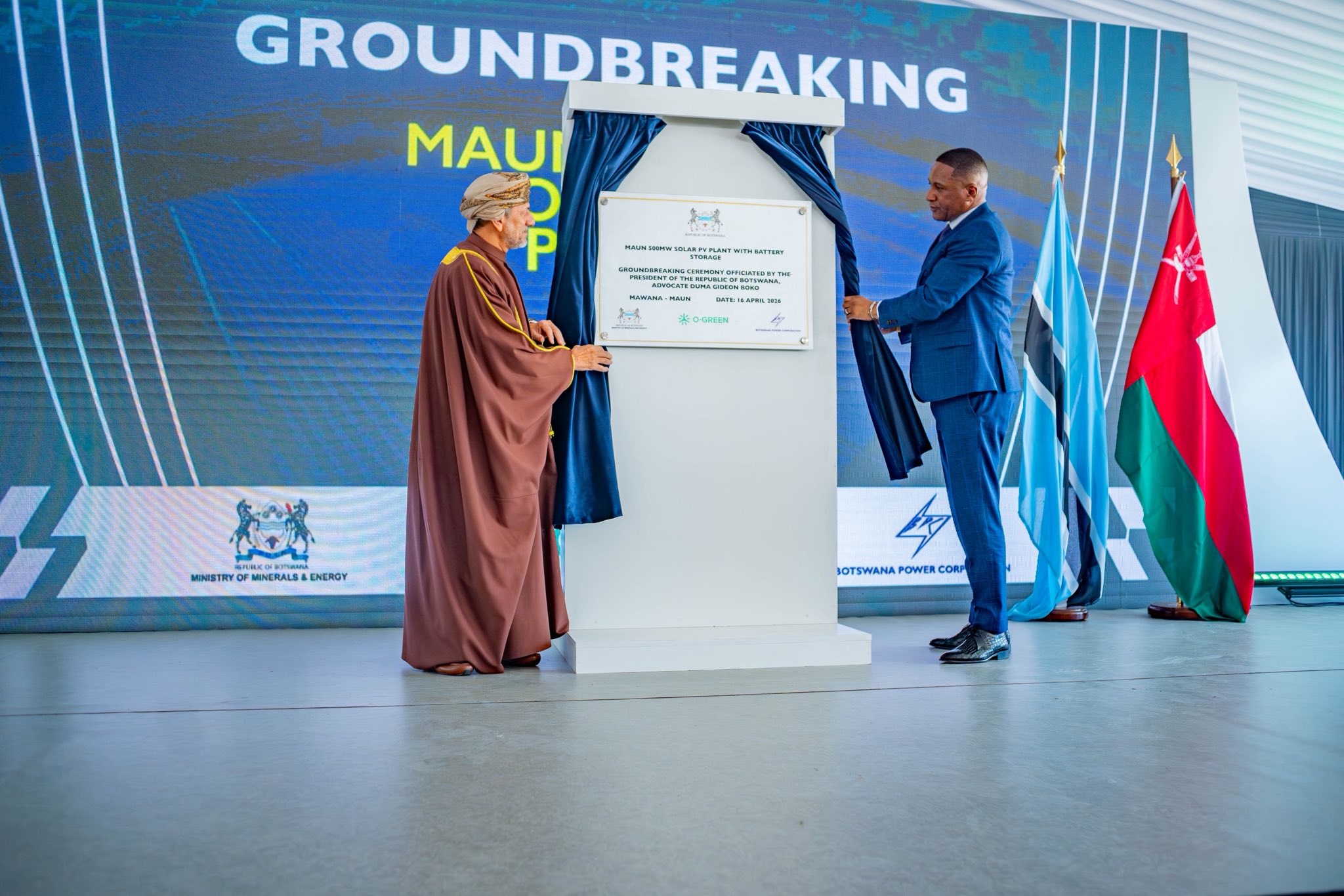
Botswana is moving to insulate itself from rising electricity costs and supply uncertainty, with the 500MW Maun Solar PV project expected to provide a critical buffer against expensive power imports and grid instability.
Speaking at the groundbreaking ceremony, Botswana Power Corporation (BPC) Chief Executive Officer David Kgoboko said the project marks a turning point in how the country manages its energy needs, taking it away from dependence to greater self-sufficiency.
For years, Botswana has relied heavily on imported electricity during peak demand periods, particularly in the evenings and early mornings. These imports often come at a high cost, exposing the country to price shocks and external supply risks.
Kgoboko said the Maun project is designed to directly address this challenge.
At the centre of the development is a 500 megawatt-hour battery energy storage system, which will allow electricity generated during the day to be stored and used when demand peaks. This includes the costly evening window between 6pm and 10pm, as well as early morning hours when imports are typically highest.
“This is where the real benefit lies,” Kgoboko indicated, noting that the country will be able to rely on its own stored energy instead of turning to expensive imports.
The system is also designed with flexibility in mind. The battery can be charged using solar power during the day and recharged again during off-peak hours overnight, ensuring a steady reserve of energy that can be deployed when needed most. This capability is expected to significantly reduce the cost of electricity generation while improving supply security.
Beyond cost savings, the project is set to stabilise Botswana’s power grid. Solar generation can fluctuate due to weather conditions such as cloud cover, but the battery storage system will smooth out these variations, ensuring consistent supply and reducing the risk of outages.
Kgoboko mentioned that this is a major advancement from Botswana’s existing solar projects in Maun and Jwaneng, both of which operate at 100MW and lack storage capacity. By integrating battery technology at scale, the new plant introduces reliability into the renewable energy mix.
The project, developed in partnership with Oman, will be implemented under an Independent Power Producer model and operated by Okavango Solar under a 30-year power purchase agreement with BPC.
Once completed, targeted for early 2029, the plant is expected to strengthen Botswana’s energy security, lower reliance on imports, and reduce the country’s carbon footprint.
In the long term, Kgoboko said the project could position Botswana as a net exporter of electricity within the region


