


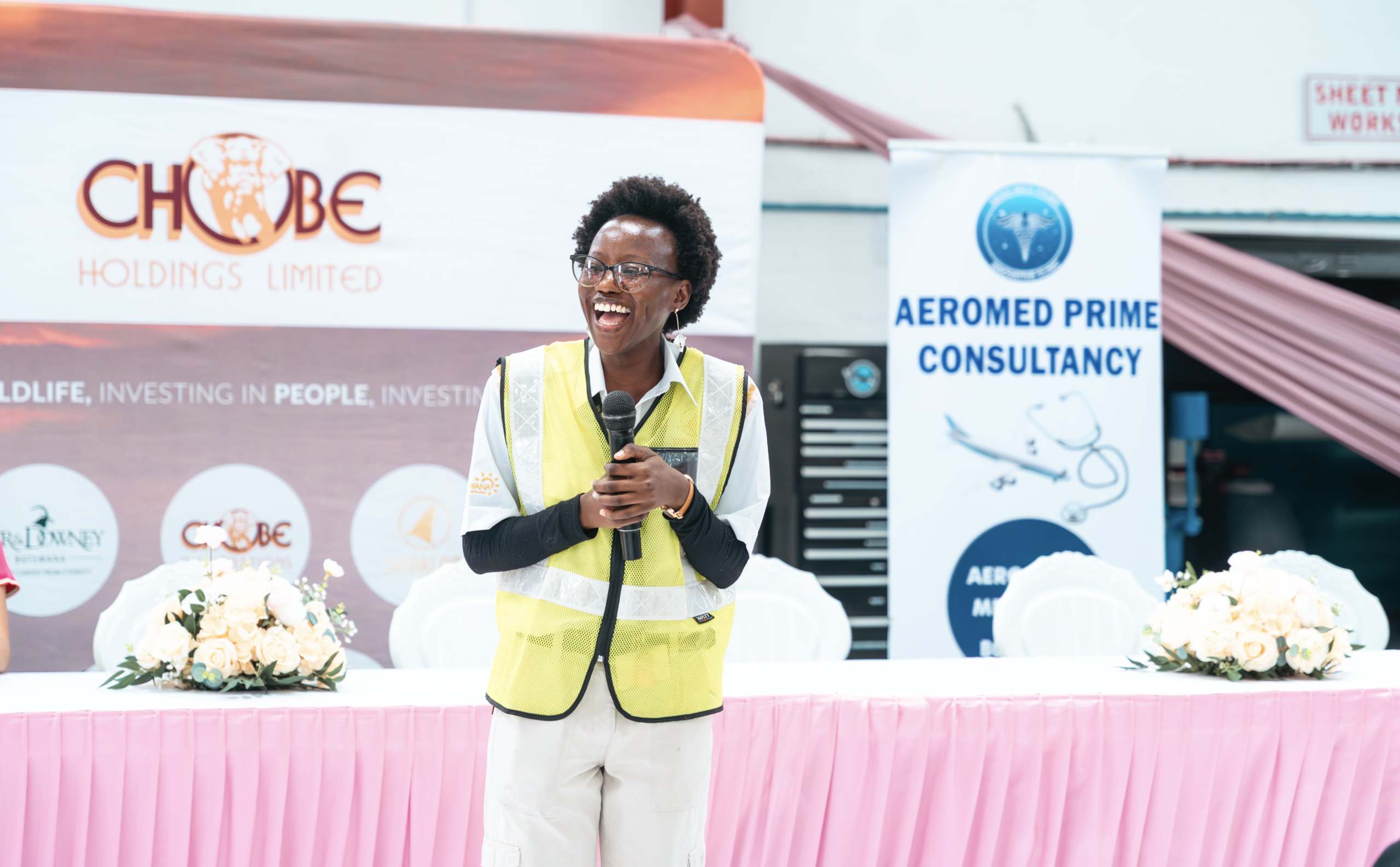
Virginia Mofa, the 27-year-old who dared to dream at six and became one of Chobe Holdings’ first female pilots
From a little girl who told her parents she wanted to fly, to commanding a Cessna Caravan over the Okavango, Botswana’s trailblazing aviator on faith, turbulence, and why the sky must belong to girls too.
There are pilots who fly by instruments, and pilots who fly by faith. Virginia Mofa does both.
At 27, with a Commercial Pilot Licence, multi-engine, instrument and night ratings in her logbook and two workhorses, the GA8 Airvan and the Cessna 208 Caravan, under her wings, Mofa is carving a quiet revolution in the skies above the Okavango Delta.
Operating under Safari Air, the aviation wing of Chobe Holdings Limited, Botswana’s leading ecotourism group, she stands as one of the first ever female pilots hired in the company’s history.
Her story does not start on a runway. It starts in a childhood memory.
“As a little six-year-old young lady, I told my parents I wanted to be a pilot,” she recalls, smiling. “They thought I was crazy, but in a fun way. They were like, ‘Ah, she’s just a girl, she’s going to grow up.’ And then I managed to, and I still told them I wanted to be a pilot.”
Fresh out of high school after Form Five in 2018, she did not apply for anything else. With government sponsorship, she went straight to ‘43 Air School in Port Alfred, South Africa, one of the continent’s most rigorous flight schools.
“It took me approximately two years. It would have been a year and some months had COVID not hit. I started in 2018 and graduated in 2020,” she says.
She came home to a grounded world.
When Aviation Hits You Hard
COVID-19 shut the skies. For a year and a half, there was no employment. Licences lapse. Currency fades. And aviation, as every pilot learns, is brutally expensive when you are on your own.
“That’s where aviation starts to hit you hard. You start to see that it’s very expensive and you have to do it by yourself,” Mofa says. “I managed to get some cash and then I managed to revalidate my licence.”
Then came the opening that would change everything. Safari Air, in a historic hiring season, was hiring only women.
“Apparently we became the first two veteran women to be hired ever in this company,” she says. She was hired in 2022 and started her contract in 2023. Almost four years later, she is a familiar voice over the Okavango Delta, threading tourists, supplies and hope between remote airstrips.
Ask her what flying in the Okavango is really like and she does not romanticise it. She reveres it.
“This is one of the best careers I could have ever chosen for my life because every day you work by faith and not by sight,” she says.
Today it is wind. Tomorrow it could be birds, sudden weather, a busy frequency.
“Your listening skills have to be on point because you have to listen out for other traffic, air traffic controllers, and at the same time you’re talking as well. So it entails a lot of things. Be able to be versatile and be good at multitasking. Don’t fixate. Learn to let go if it doesn’t work and focus on what you need to focus on.”
And if you want to follow her path? She is precise: “Study Maths, Science and English. Do absolutely well in those because we work with those every day, and also your Geography and a little bit of Physics, just to know the forces behind the machine.”
To say “women in aviation” is easy, Mofa says. To live it is different.
“As a woman, you have to work a little bit harder than the gentlemen, because the gentlemen already have some kind of inspiration ahead of them. They have so many role models. For us, there are not a lot that look like us.”
The body, the system, the machine , she had to learn to work with all of it, quickly. The transition from flight school, just you and your instructor, to operations, where you fly passengers alone, where you meet guests from all over the world and must find your voice in front of them, was its own turbulence.
“Maybe fear of speaking in front of so many guests because you meet so many people from all over the world. So you have to learn to interact with them.”
And the learning never lands. “If you’re coming to aviation, forget about being lazy. You study every time. There’s not a break. There are tests that you have to do frequently, like after six months and all that stuff, to keep recent.”
Bringing Girls Into The Cockpit Of Possibility
That is why this year’s Girls in Aviation Day in Maun, which was sponsored by Chobe Holdings means so much to her.
For years, she had watched from afar as South Africa, Tanzania and Ghana hosted initiatives to pull young girls into STEM and aviation. Nothing quite like it existed at home in Botswana.
This year, by the grace of God, she says, she was selected under Women in Aviation International as the coordinator for the North West District. The event, held in Selebi-Phikwe, marks the 12th year of Girls in Aviation globally, and the biggest Maun has ever seen.
“Most of the time we are occupied with the schedules and all that. So we hardly have time to even go to the schools and reach out to those girls. So now when they come to us, it’s much easier to bring them into our world,” she explains.
Her goal is not just to create pilots. It is to show the engine behind the pilot.
“In aviation it’s so wide, like the field is so big. There are doctors, there are safety managers, operations managers, pilots, briefing officers, scheduling and flight following. It’s not just pilots behind the aviation field. They only see the pilots because we are highly advertised, but there’s an engine running behind for the pilot to be able to take off and land.”
“If they’re interested in tourism, but with aviation, there is a slot for them. If they’re interested in décor and all that in aviation, there is a slot for them. If they’re interested in the medical part, it is part of it. There’s no limitation.”
For Chobe Holdings, a company built on showcasing Botswana’s wilderness to the world, Virginia Mofa is more than a pilot. She is a symbol that the future of ecotourism will not just be flown over the Delta, but flown by the daughters of the Delta itself.
And somewhere, a six-year-old girl is watching a Caravan disappear into the sky over Maun, and whispering to her parents, “I want to be a pilot.”


