


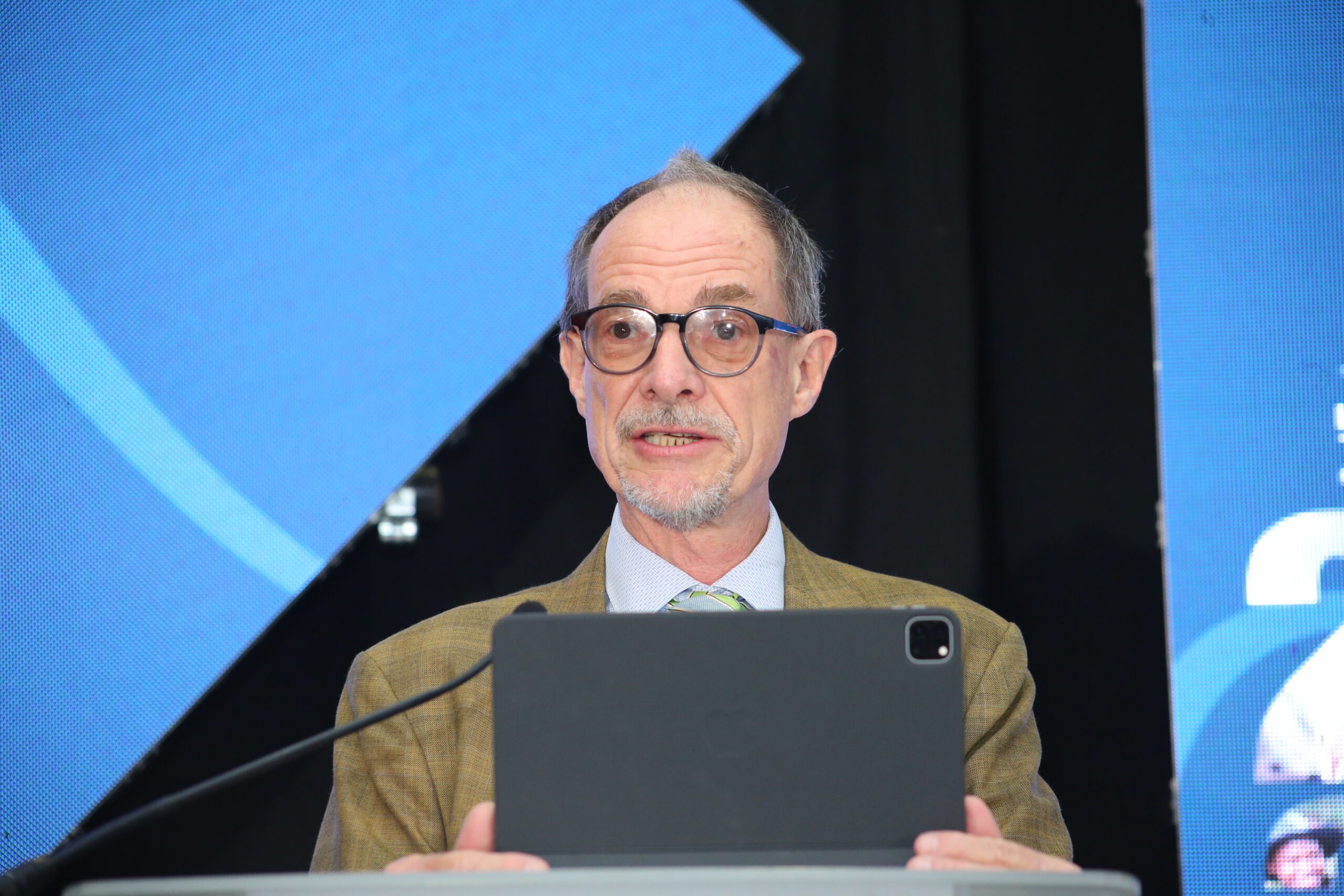
Botswana’s public debt is on track to reach 50 percent of GDP by 2027/28, while debt-servicing costs are rising faster than accounted for in the Ministry of Finance’s budget projections, according to economist Dr Keith Jefferis.
Jefferis’ findings, published in Econsult’s Q1 2026 Economic Review, warn that without significant reductions in government spending, Botswana could face a debt crisis within five to ten years.
“The inevitable conclusion is that without meaningful expenditure restraint — bringing spending down below 30 percent of GDP — Botswana could face a debt crisis within the next 5 to 10 years,” Jefferis states.
According to the quarterly review, public debt and guarantees stood at 21 percent of GDP in 2023, rising to an estimated 30 percent by March 2025 and about 38 percent by March 2026.
During his 2026/27 budget presentation, Finance Minister Ndaba Gaolathe said public debt, including guarantees, is projected to reach 44.66 percent of GDP by the end of the financial year.
In response, Parliament raised the statutory debt ceiling from 40 percent to 60 percent of GDP to accommodate the government’s borrowing plans.
The sharp increase follows the near-depletion of the Government Investment Account (GIA), a savings reserve held at the Bank of Botswana that has historically been used to finance budget deficits without borrowing.
Jefferis noted that the GIA peaked at P41.7 billion in March 2015 but had fallen to less than P500 million by September 2025.
With the account effectively exhausted, all budget deficits must now be financed through new borrowing, he said.
However, Jefferis warned that rising borrowing costs have received insufficient attention in debates on debt sustainability.
When government issued Botswana’s first 25-year bond in September 2018, the yield was 5.2 percent, which Jefferis described as “an exceptionally low interest rate for such a long-term government bond, reflecting GoB’s investment-grade credit rating and favourable balance sheet.”
When three-month Treasury bills were introduced in 2020, they yielded 1.08 percent, “well below the rate of inflation,” he said.
But following the rapid rise in government borrowing since 2023, yields have climbed sharply. By March 2026, the three-month T-bill rate had reached 10.33 percent, while the new 25-year bond carried a yield of 13.3 percent. A five-year commercial loan of P750 million from Standard Chartered Bank carried an interest rate of 13.7 percent.
Jefferis said the effective interest rate on government debt has risen from 2.9 percent in 2014/15 to 5.5 percent in 2024/25, and is projected by Econsult to increase further to 7.5 percent by 2027/28.
However, the Ministry of Finance projects the rate will fall to 2.2 percent by 2027/28 — a forecast Jefferis described as “not credible.”
Based on revised assumptions, Econsult estimates that interest payments will rise to 9.7 percent of total government spending by 2027/28, equivalent to about P10.1 billion — “a similar size to the current public health budget,” Jefferis said.
For most of the three decades between 1990 and 2020, interest payments averaged 1.4 percent of government spending and remained below 2 percent. By 2024/25, they had risen to 3.7 percent.
While official projections suggest interest costs will decline after 2024/25, Jefferis said this is inconsistent with prevailing borrowing conditions.
“With rising levels of debt and rising interest rates, the interest burden on the budget will inevitably increase,” he said.
He estimates that the average interest rate on government debt will reach 7.5 percent by 2027/28, while annual GDP growth is expected to average 1.7 percent between 2026 and 2030.
Under these conditions, a primary budget surplus of about 0.5 percent of GDP would be required to stabilise debt.
However, Ministry of Finance projections show primary deficits of 8.2 percent of GDP in 2025/26, 7.9 percent in 2026/27, and 5.9 percent in 2027/28.
“When combined with our higher estimates of interest payments, these will drive a rapid increase in debt (including guarantees), from 30 percent of GDP in 2024/25 to 50 percent in 2027/28 — clearly not a sustainable trend,” Jefferis said.
“Government is not running a primary budget surplus, or even a balanced budget, as debt sustainability would require,” he added.
Econsult also documented difficulties in meeting domestic borrowing targets in 2025/26. Government had aimed to raise P10 billion — P2 billion through Treasury bills and P8 billion through medium- and long-term bonds.
By December 2025, three-quarters into the financial year, only P3.1 billion had been raised.
“Borrowing was ramped up in the final quarter by allowing auctions to clear at higher interest rates, taking the total to P8.1 billion,” Jefferis said.
Bond issuance fell well short of target, raising only P3.9 billion, while Treasury bills exceeded expectations at P4.2 billion against a P2 billion target.
To cover the shortfall, government reactivated a short-term facility with the Bank of Botswana, drawing P2.8 billion in November 2025.
More significantly, in March 2026, government concluded a P14 billion loan package with a consortium of domestic banks — the first time in Botswana’s history that such a facility was partly denominated in US dollars and euros, reflecting what Econsult described as a “lack of pula liquidity” in the domestic market.
The lenders included Stanbic, Standard Chartered, First National Bank Botswana and ABSA.
With the medium-term budget indicating total borrowing of up to P56 billion over 2026/27 and 2027/28, Jefferis said raising funds will become increasingly difficult as domestic markets appear “almost exhausted.”
He warned that Botswana may become increasingly reliant on external borrowing in foreign currencies, exposing the country to exchange-rate risk.
Jefferis further cautioned that rising interest payments could begin squeezing out priority spending.
“These projections do not indicate an imminent debt crisis, with debt remaining at a manageable level, at least for the next two years,” he said. “However, the trend is unsustainable, and it would not take long for debt to reach crisis levels at this rate.”
“With continued deficits of this magnitude, debt could exceed 100 percent of GDP within a decade — perhaps sooner if borrowing costs continue to rise.”
He concluded that public spending reform remains urgent, with lower spending and smaller deficits needed to avoid a potential debt spiral.


