


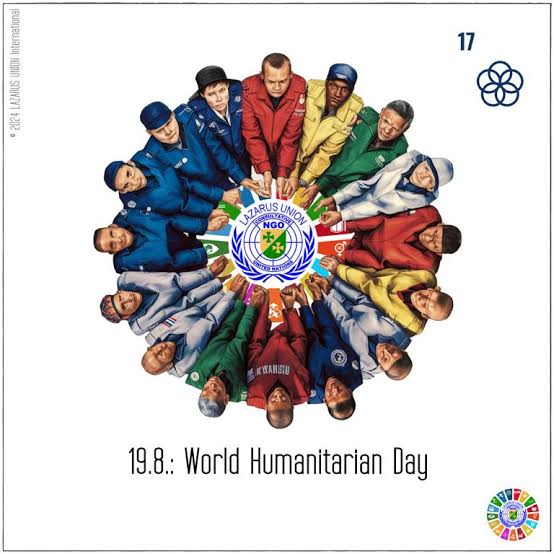
Every year on 19 August, the world observes World Humanitarian Day – a day associated with extraordinary courage: humanitarian workers entering conflict zones, medical teams working through disasters, volunteers distributing food, and ordinary people choosing to help when circumstances are anything but ordinary.
The day carries a painful history, established after the 19 August 2003 bombing of the United Nations headquarters at the Canal Hotel in Baghdad, which killed 22 humanitarian workers and injured more than 100 others.
More than two decades later, the danger has intensified rather than faded. In 2025, 907 humanitarian workers were reportedly killed, injured or kidnapped worldwide; 350 of them died. Those numbers should stop us. But World Humanitarian Day should also push us to think about humanity closer to home – inside our own organizations. Humanitarianism rests on one simple principle: human beings matter. That principle should not only apply during a war, flood, famine, or national emergency. It should apply on an ordinary Monday morning too. This is where culture and World Humanitarian Day meet: both ask the same question – do we see the person, or only the crisis, the role, the output?
What Does Humanity Look Like at Work?
Organizations speak extensively about targets, productivity, efficiency, and growth. All of those matter. But somewhere between the strategy meeting and the performance dashboard sits a human being – someone grieving, caring for an ageing parent, struggling financially, sleepless, or quietly worn down by how they are spoken to.
The question is not whether organizations should abandon standards because people have difficult lives. They should not. The question is whether we can hold high standards and humanity at the same time. Humanity is not the opposite of accountability. Compassion is not the absence of performance. Kindness is not poor leadership.
Sometimes the most humane act a leader can offer is a difficult conversation held honestly and early. Sometimes it is flexibility when life becomes overwhelming, or asking one more question before judging, or simply noticing. That is culture – the same instinct that sends a humanitarian worker toward, not away from, a crisis.
The People Who Care for Others Need Care Too
There is another lesson hidden in humanitarian work: the people doing the caring are human too. A 2024 systematic review of nine studies covering 3,619 humanitarian workers found reported burnout ranging from 8.5 percent to 32 percent, depression from 10.4 percent to 39 percent, and psychological distress reaching as high as 52.8 percent in some samples.
Importantly, the difficulty of the work is not always the main driver. A 2026 review in the International Review of the Red Cross points to workload, role ambiguity, inequitable reward systems, managerial practices and workplace culture as organizational factors behind that distress. The finding should travel far beyond humanitarian organizations: every workplace should ask whether people are exhausted because the work is difficult, or because difficult work has been made unnecessarily harder.
There is a difference. Some pressure comes with responsibility; some stress comes with ambition. But confusion, disrespect, unnecessary bureaucracy, poor leadership, chronic understaffing, fear, favoritism and unreasonable workloads are not inevitable features of working life. They are culture conditions – and culture conditions can be changed.
We Cannot Keep Celebrating Resilience While Ignoring the System
There is something admirable about resilience. Humanitarian workers demonstrate it daily, as do nurses, teachers, police officers, entrepreneurs, public servants and parents quietly holding families together while still arriving at work each morning. But organizations should be careful not to romanticize resilience so much that it becomes an excuse for poor systems. We should not keep asking people to become stronger simply so they can survive environments that refuse to become healthier.
Research among humanitarian workers in northern Uganda offers a clue: higher levels of social support and stronger team cohesion were associated with better mental-health outcomes. Culture matters. Who checks on you matters. Whether your manager listens matters. Whether asking for help makes you look weak, or whether mistakes become opportunities to learn rather than to humiliate – these small experiences determine whether an organization merely employs human beings or actually remembers their humanity. That is the connective tissue between World Humanitarian Day and everyday organizational life: both are tests of whether a system was built to notice people or to overlook them.
Humanity Is a Culture Standard
Perhaps World Humanitarian Day offers organizations a chance to reconsider what “good culture” really means. It cannot simply mean Friday lunches, wellness days and values painted on reception walls.
Humanity becomes visible when someone makes a mistake, becomes ill, or disagrees with leadership; when a colleague experiences loss, pressure is high and patience is low, or restructuring becomes necessary. Culture is revealed most clearly in how people are treated when treating them well becomes inconvenient. That is where values stop being words and become evidence.
Before We Change the World
World Humanitarian Day honors people who step into humanity’s darkest moments to help. Their courage deserves recognition; their sacrifice deserves protection. Perhaps their example should also leave something with the rest of us.
Humanity does not always require crossing a border or entering a disaster zone. Sometimes it is the leader who listens before judging, the colleague who notices someone struggling, the organization that refuses to sacrifice dignity in pursuit of performance, the team that understands that people can be accountable without being dehumanized.
On World Humanitarian Day, the challenge is beautifully simple: before we ask how we can make a difference in the world, we should ask what it feels like to be human inside our own organizations. Humanity should never begin only at the point of crisis. It should be part of the culture long before one arrives.
At The Culture Leadership Group, we help organizations build cultures where humanity and performance do not have to compete. Contact us at aminahm@thecultureleadership.com or +267 78131421.


